

Investment is one of the main pillars in driving national economic growth, particularly in strengthening industrial structures, creating employment opportunities, and enhancing Indonesia’s global competitiveness. In recent years, Indonesia has demonstrated positive investment performance despite global economic challenges, supported by strategic policies such as natural resource downstreaming and improvements in the ease of doing business.
Indonesia’s investment performance in 2025 demonstrates resilient growth amid global uncertainty. As one of the leading emerging markets in Southeast Asia, Indonesia continues to attract Foreign Direct Investment (FDI), supported by strong domestic demand, abundant natural resources, and ongoing structural reforms. Investment remains an important driver of economic growth, playing an important role in industrial development, job creation, and long-term competitiveness.
Throughout 2025, investment flows into Indonesia reflected changing global dynamics while further strengthening the country’s strategic position within regional and global value chains. Several countries continued to dominate as major investors, indicating strong confidence in Indonesia’s economic outlook. At the same time, investment across sectors remained concentrated in industries that align with national development priorities.
In 2025, the Indonesian Ministry of Investment and Downstreaming/BKPM recorded total investment realization of IDR 1,931.2 trillion, reaching 101.3% of the Presidential target of IDR 1,905.6 trillion.
Source: Ministry of Investment (BKPM)
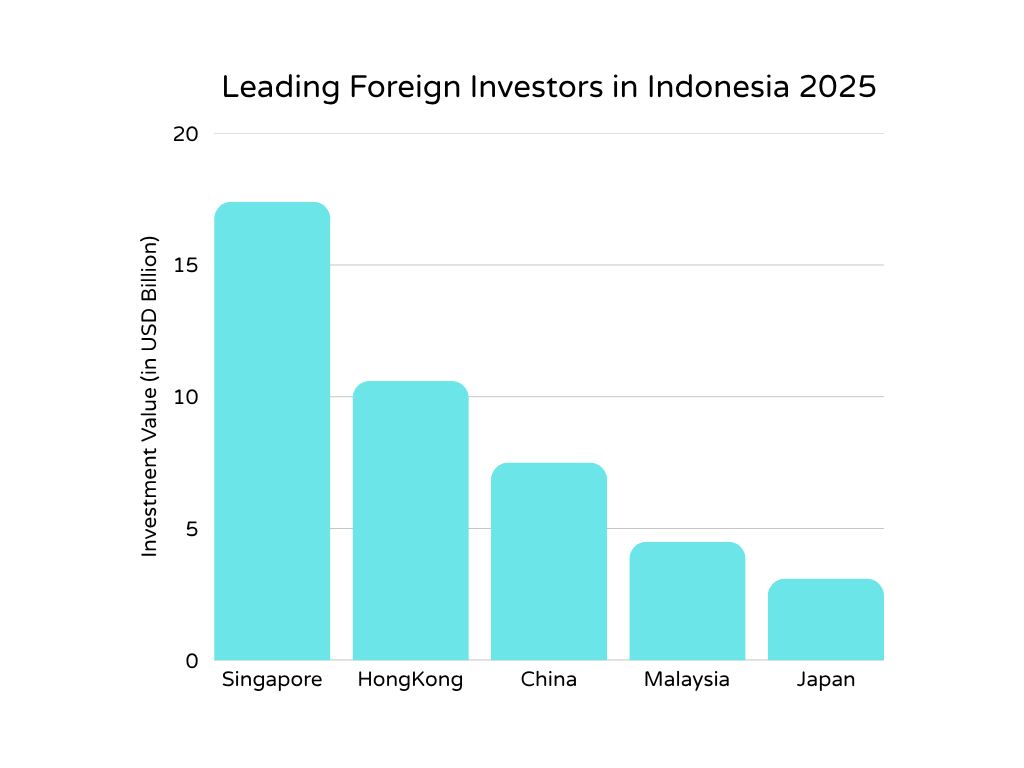
Based on Indonesia’s investment realization data from January to December 2025, Foreign Direct Investment (FDI) continued to originate primarily from key partner countries in Asia. Singapore was the largest investor, with a total investment value of USD 17.4 billion. Its strong position is driven by its role as a regional financial hub and a gateway for global capital entering Indonesia. In second place is Hong Kong, with USD 10.6 billion in investment. Similar to Singapore, Hong Kong acts as a global financial center and a bridge for cross-border investment.
China ranked third, with USD 7.5 billion in investment. Its role has grown significantly in recent years, supported by strong bilateral cooperation. Malaysia followed with USD 4.5 billion in investment. Its geographical proximity and long-standing economic relationship with Indonesia help maintain stable investment flows. Meanwhile, Japan recorded USD 3.1 billion in investment and remains a consistent long-term investor in Indonesia. Japanese investments are concentrated primarily in manufacturing, automotive, electronics, and infrastructure.
Overall, the composition of the top five investing countries indicates that foreign investment in Indonesia remains concentrated among Asian economies. This is largely due to their geographical proximity, strong economic ties, and integration within regional supply chains.
Source: Ministry of Investment (BKPM)
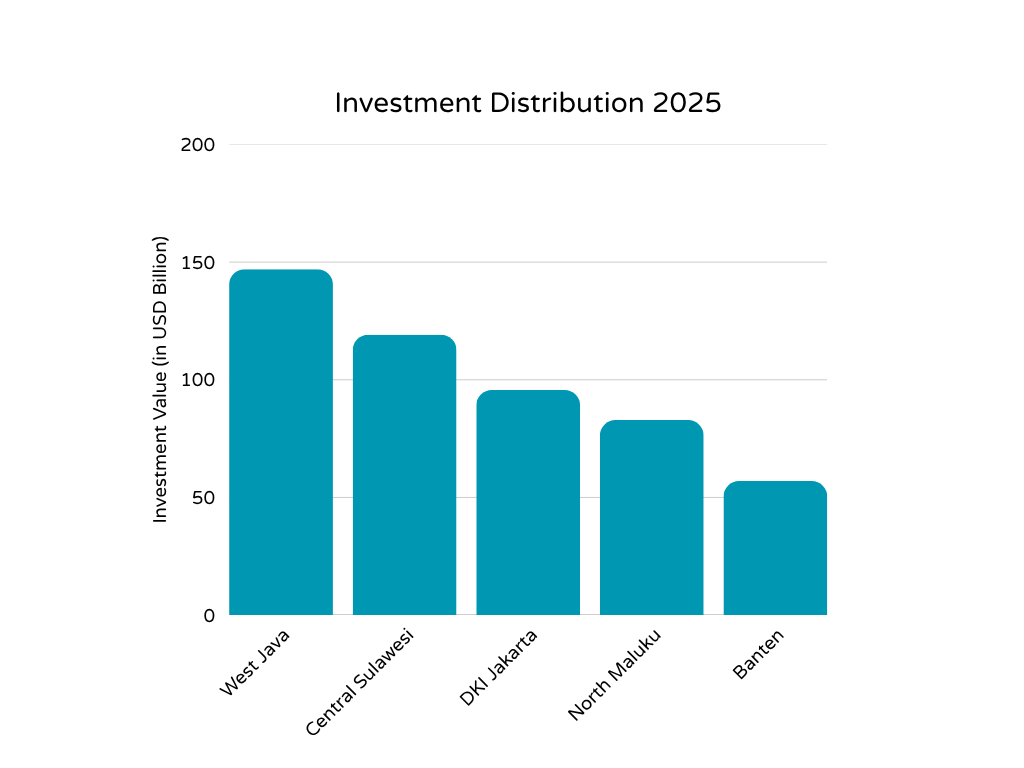
In addition to the countries of origin, the chart also illustrates the distribution of investment across regions in Indonesia in 2025, showing that investment depends not only on where it originates, but also on the attractiveness of each region is. First, West Java recorded the highest investment realization, at approximately USD 145 billion. This is largely due to its numerous industrial estates, well-developed infrastructure, and proximity to the capital city. The province serves as a major center for manufacturing and industrial activities. Central Sulawesi came next with around USD 120 billion in investment. Investment in the province is driven primarily by natural resources, particularly nickel processing, which plays an increasingly important role in global supply chains, including electric vehicle battery production.
Third, DKI Jakarta recorded approximately USD 95 billion in investment. As the country’s primary business and administrative center, it attracts investment in services, finance, technology, and trade, despite not being a major hub for heavy industry. Fourth, North Maluku recorded around USD 80 billion. Similar to Central Sulawesi, investment in the province is supported by mining and mineral processing activities, which continues to benefit from strong global demand. Lastly, Banten recorded around USD 55 billion. Although lower than other regions, Banten remains an important industrial area due to its proximity to Jakarta and access to major ports.
Source: Ministry of Investment (BKPM)
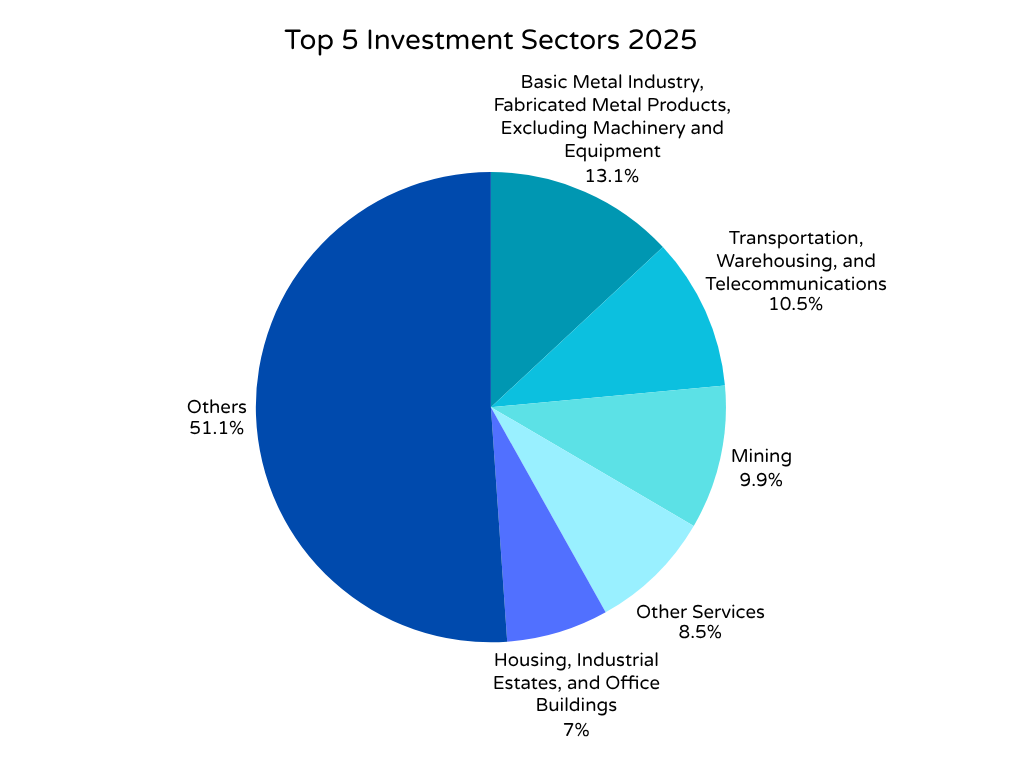
Based on the investment distribution in 2025, capital flows in Indonesia remained concentrated in strategic sectors that play an important role in driving economic growth and industrialization.
The basic metal industry and fabricated metal products (excluding machinery and equipment) ranked first, contributing 13.1% of total investment. This dominance is closely linked to the government’s downstreaming policy, particularly for commodities such as nickel. The transportation, warehousing, and telecommunications sector followed, contributing 10.5% of total investment. The mining sector ranked third, contributing 9.9%. Although Indonesia continues to promote downstreaming, the sector remains highly attractive to investors due to the country’s abundant natural resources, including minerals and energy resources.
Meanwhile, other services accountedfor 8.5% of total investment. This category reflects increasing diversification into service-based sectors, including business support services and professional services. Next, the housing, industrial estates, and office buildings sector contributed 7% of total investment. Investment in this sector is driven by rising industrial activity and the need for supporting infrastructure, including integrated industrial zones and commercial office spaces.
Overall, although several sectors dominate investment realization, more than half of total investment is still spread across various other sectors (51.1%). This indicates that Indonesia’s investment structure is relatively diversified and continues to offer growth opportunities beyond its core sectors.
In general, Indonesia’s investment pattern in 2025 demonstrates a stronger focus on strategic, high value-added sectors while maintaining diversification across industries. The dominance of investors from Asia, combined with strong investment in manufacturing, infrastructure, and resource-based industries, reflects Indonesia’s growing importance within global value chains. This not only strengthens the country’s economic foundation but also supports a more sustainable and competitive industrial transformation in the years ahead.
This positive trend continued into early 2026. In the first quarter (January–March) of 2026, investment realization reached IDR 498.8 trillion, growing by 7.2% year-on-year (YoY). This achievement represents approximately 24.4% of the 2026 national investment target of IDR 2,041.3 trillion. The growth indicates that investor confidence in Indonesia remains strong and reflects solid momentum toward achieving the annual investment target. With this trend, Indonesia has a significant opportunity to further strengthen its investment attractiveness at both regional and global levels.
Source: Ministry of Investment and Downstreaming / BKPM
Written by Nada Putri Naila – Kadin Business Service Desk