
What Does the Indonesia–South Korea Digital Partnership Mean for Indonesian Businesses?

On April 1st, 2026, Presidents Prabowo Subianto and Lee Jae-myung elevated Indonesia–South Korea bilateral relations to a “Special Comprehensive Strategic Partnership”, the first of its kind between the two countries. Among the 16 MOUs signed at the Blue House summit in Seoul, the Digital Development Cooperation agreement stands out as one of the most consequential for Indonesian businesses, entrepreneurs, and the country’s rapidly growing AI and technology ecosystem
A Digital Economy Ready for the Next Phase
Indonesia’s digital economy is approaching a pivotal threshold. According to Indonesian Internet Service Providers Association (APJII), Internet users have surpassed 221 million with a penetration rate of 79.5%, and the country remains the largest digital economy in Southeast Asia, accounting for approximately 33% of the region’s total digital market
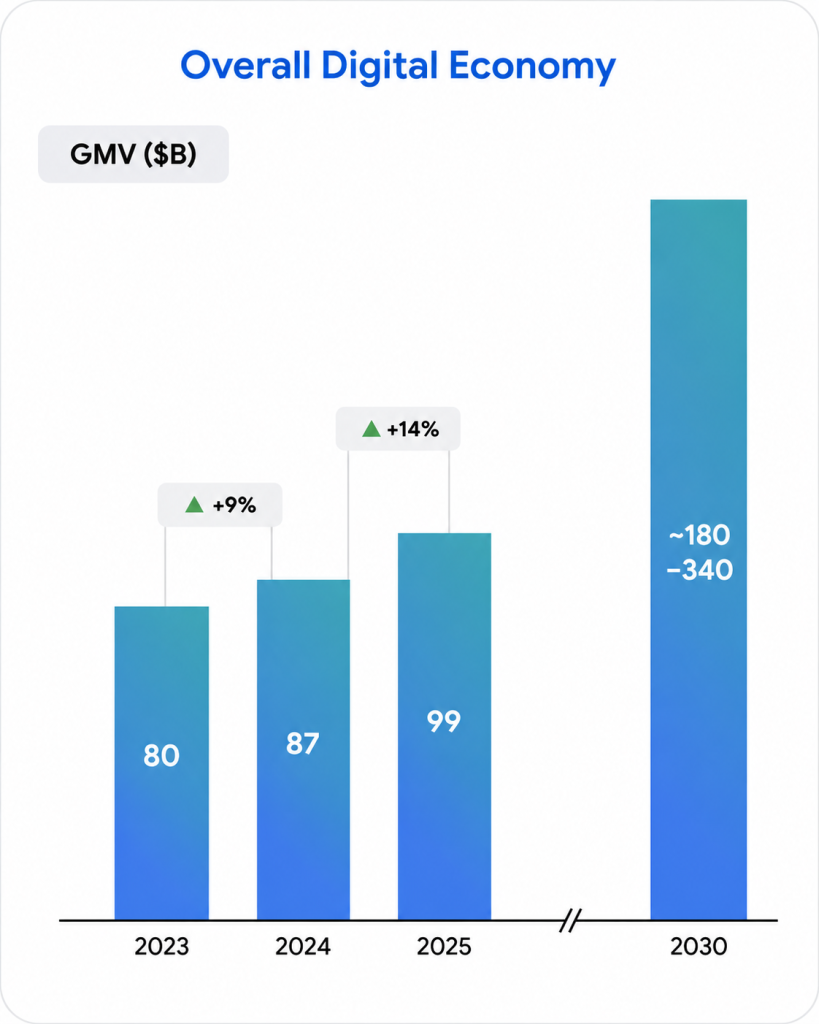
Source: Bain & Company
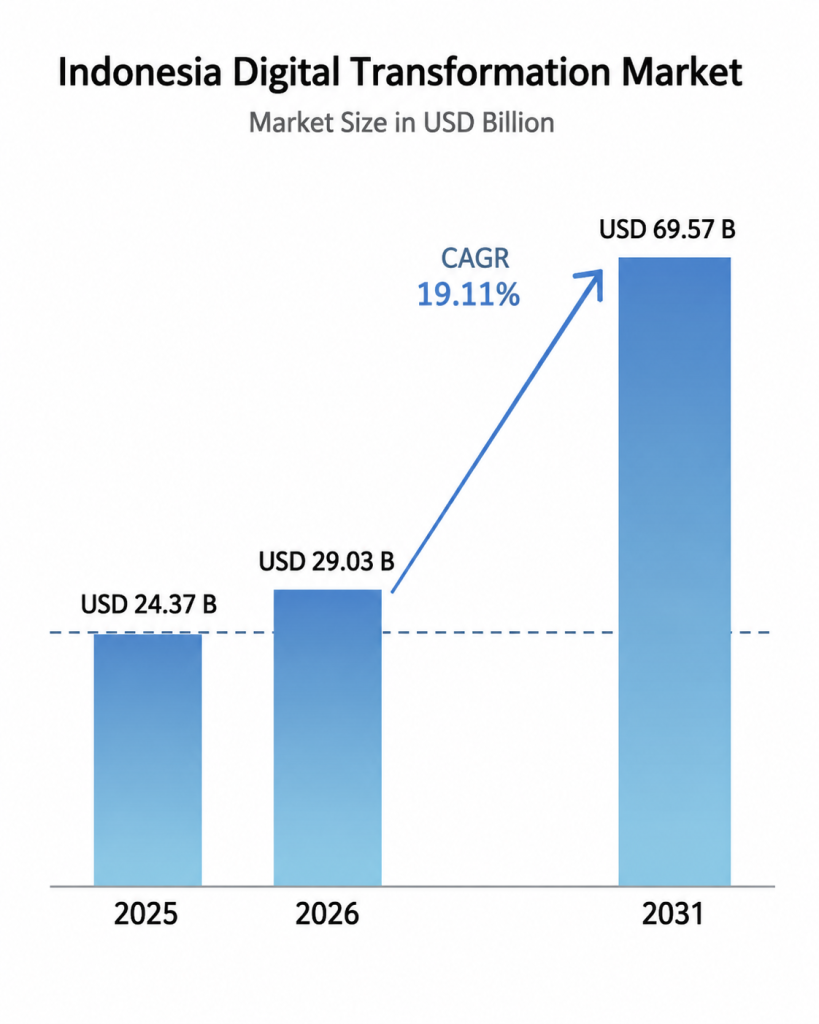
Source: Mordor Intelligence
Indonesia’s digital economy is projected to reach between USD 180 billion and USD 340 billion by 2030, growing from a strong foundation in e-commerce, fintech, online travel, and digital media. The country’s digital transformation market is projected to reach USD 69.57 billion by 2031, at a CAGR of 19.11%. Despite this momentum, a critical gap persists as Indonesia still needs 9 million additional digital workers over the next 15 years, requiring 600,000 trained annually despite Indonesia fast adaption in AI adoption
What the April Summit Actually Delivers
The Digital Development Cooperation MOU signed at the April summit is structured around three concrete pillars: internet accessibility and digital public services, data protection and information security, and AI talent development through training, scholarships, and expert exchange programs
South Korea has committed to building High-Performance Computing (HPC) infrastructure in Indonesia using domestically produced Neural Processing Units (NPUs) with delivery targeted for H1 2026. Both governments will establish a Joint Committee on Digital Development Cooperation to oversee implementation. Source: Digital Today Korea (Ministry of Science and ICT), April 2, 2026
For Indonesia’s digital startup community, the MOU is expected to expand growth prospects for digital entrepreneurs and create new pathways to Korean technology networks and capital
Korea’s Digital Footprint Is Already Here
The April summit did not build the Korea–Indonesia digital relationship from nothing, it ratified and accelerated one that has been quietly deepening for years. In the financial sector alone, 27 Korean financial companies currently operate 32 branches across Indonesia. Mirae Asset Securities Indonesia has held the top market share in Indonesian stock trading for three consecutive years in 2023
In the technology sector, Samsung and LG are actively investing in 5G network development across Jakarta, Surabaya, and Medan. Smart city projects in Bandung and Makassar, integrating Internet of Things (IoT), digital security, and traffic management systems have been built with Korean technical expertise cooperation. The Korea-ASEAN Digital Flagship Project has been contributing to Official Development Assistance for High Performance Computing (HPC) infrastructure in Indonesia since 2024, making the H1 2026 delivery target an acceleration of ongoing work rather than a new commitment. Source: Korea Times (FSC bilateral forum) 2023, IJPSAT Academic Journal Indonesia-South Korea Technology Cooperation 2024
Indonesia’s AI Agenda and Korea as a Reference Model
South Korea serves as a direct reference model. Korean regulations already require companies to label AI-generated content, with fines of up to 30 million KRW (~IDR 347 million) for non-compliance, a framework Indonesia’s policymakers are actively studying
Source: Indonesia Business Post (citing Komdigi Minister Meutya Hafid), January 27, 2026
Indonesia has identified AI regulation as a key national agenda for 2026. Two major frameworks are in preparation: a Presidential Regulation on the National AI Roadmap and Guidelines on AI Safety and Ethics. Once enacted, all ministries will be required to issue derivative AI regulations for their respective sectors, signaling that the government is moving from aspiration to institutional architecture
Written by Josua Pandapotan Sihotang – Kadin Business Service Desk